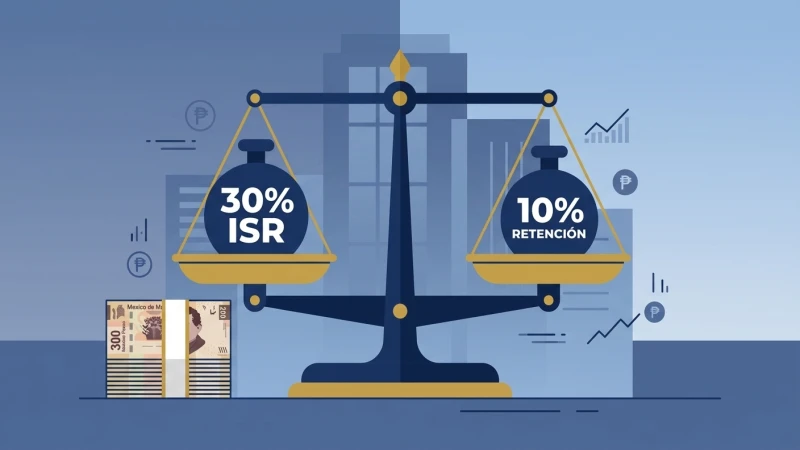
Dividends paid by a Mexican corporation to a resident individual carry two combined tax layers: the 30% corporate ISR the company already paid when it earned those profits, plus a definitive additional 10% withholding applied at distribution (Art. 140 LISR). If the dividend comes from the CUFIN — the account tracking profits that already went through corporate ISR — the company pays no extra ISR and the combined effective rate is 37%. Without CUFIN coverage, the company applies the pyramiding factor 1.4286 (Art. 10 LISR) and the real rate can reach 42% for shareholders in the top marginal bracket. The difference between one scenario and the other can run to hundreds of thousands of pesos in a single distribution.
Why Mexican dividends carry two tax layers, not one
The fiscal architecture of dividends in Mexico follows a logic that many partners do not understand until they see the first unexpected bill. The company paid 30% ISR on its profits. When it distributes those profits as dividends, the receiving individual includes them in their annual return and calculates their personal ISR — but can credit the ISR already paid by the company. The gap between the 30% corporate rate and the personal rate (which can reach 35%) is what the individual pays additionally.
So far, the logic is reasonable. The problem is the additional 10% under Art. 140 LISR applied to the gross dividend amount, which cannot be credited against any other tax. It is definitive. If the partner receives $700,000 MXN in dividends, $70,000 goes directly to SAT with no possibility of recovery. This additional 10% has existed since the 2014 reform and was designed to equalize the tax burden on capital income with that of labor — with results still debated among tax practitioners.
CUFIN vs. non-CUFIN: the distinction that determines whether the company pays ISR on distribution
The CUFIN (Cuenta de Utilidades Fiscales Netas — Net Fiscal Profit Account) is the central record in this story. The company updates it year by year: whenever it pays ISR and generates after-tax net profits, those profits enter the CUFIN. Those that do not — because of losses, because profits were reinvested without going through the correct process, or simply because they were not properly recorded — remain outside the account.
| Item | Dividend from CUFIN | Dividend NOT from CUFIN |
|---|---|---|
| Additional ISR paid by the company | ✅ $0 — no additional ISR | ⚠️ Dividend × 1.4286 × 30% |
| 10% withholding from shareholder | 10% on the dividend | 10% on the dividend |
| Legal basis | Art. 140 LISR | Art. 10 LISR + Art. 140 LISR |
| Max effective rate (shareholder at 35%) | ~37% on original profit | ~42% on original profit |
| Credit in shareholder's annual return | Corporate ISR already in CUFIN | Pyramided corporate ISR |
| CFDI required | Yes, with dividend complement | Yes, with dividend complement |
The CUFIN is calculated and updated at the close of each fiscal year. The available balance can be verified in audited financial statements and in the corporate annual ISR declaration. Distributing dividends without checking that balance first is the most expensive mistake companies in Mexico make when distributing profits.
A consulting firm in Mexico City closed the year with $3,500,000 MXN in accumulated profits on the financial statements. The partners agreed in a shareholders meeting to distribute $2,000,000 as dividends. The external accountant did not verify the CUFIN balance — which turned out to be only $800,000. The remaining $1,200,000 was not in CUFIN. Art. 10 LISR generated an additional corporate ISR bill of $514,296 MXN ($1,200,000 × 1.4286 × 30%) that nobody had budgeted. The distribution was completed, but the company's cash position was compromised for the following month's ISR payment.
How the individual shareholder calculates dividend ISR: the 1.4286 factor step by step
When a resident individual receives dividends from a Mexican corporation, they must include them in their annual ISR return in a specific way. It is not as simple as adding the money received. Art. 140 LISR requires accumulating the grossed-up amount: the dividend multiplied by the factor 1.4286.
Numerical example: the partner received $700,000 MXN in dividends from CUFIN.
| Step | Item | Amount (MXN) |
|---|---|---|
| 1 | Dividend received (from CUFIN) | $700,000 |
| 2 | Accruable grossed-up income ($700,000 × 1.4286) | $1,000,020 |
| 3 | ISR per Art. 152 LISR at 35% (top bracket) | ~$314,000 |
| 4 | Credit: corporate ISR paid by the company (30% of $1,000,020) | -$300,006 |
| 5 | Additional personal ISR payable in annual return | ~$13,994 |
| 6 | 10% withholding already paid (definitive, not creditable) | $70,000 |
| 7 | Total tax burden on the shareholder | $83,994 |
If the shareholder is in the 30% marginal bracket or below, the 30% corporate credit covers exactly their ISR liability and the only additional tax they pay is the definitive 10% withholding — $70,000 on the $700,000 received in this example.
The 10% withholding: who pays it, when and how to remit to SAT
The 10% withholding is not paid directly by the partner — it is withheld by the paying company and that company is responsible for remitting it to SAT. Art. 140, fourth paragraph LISR establishes that legal entities distributing dividends must withhold the tax when distributing and remit it together with the provisional payment for the corresponding period.
In practice: the company agrees in assembly to distribute dividends (for example in September), pays the shareholder 90% of the agreed amount and retains 10%. That 10% is added to the September ISR provisional payment, filed by October 17. No separate additional procedure is required. The company must also issue a CFDI with the "Dividendos" complement specifying whether the dividend comes from CUFIN or not, and the withheld ISR amount. That document is what the shareholder needs for their annual return.
Dividends to foreign shareholders: Title V withholding and treaties that reduce it
For companies with non-resident shareholders, dividend distribution triggers Title V LISR provisions. The base rate under Art. 164, fraction I LISR is 10% on the gross dividend — the same as for residents. The double taxation treaties Mexico has with over 60 countries can reduce this. Spain can pay 5% if the beneficiary directly holds at least 25% of the paying company's capital. Canada pays between 5% and 15% depending on ownership. Russia and Ukraine have no active treaty with Mexico, so their shareholders pay the full 10% domestic rate.
To apply reduced treaty rates, the foreign shareholder must provide the paying company with their tax residency certificate issued by their country's tax authority. The company cannot apply the reduced rate automatically. For Russian and Ukrainian shareholders with companies in Mexico, the absence of a treaty means the dividend is taxed at 10% in Mexico with no credit available against home-country taxation — making specialist guidance from Nexoconsult on structuring distributions genuinely valuable.
The most common dividend errors SAT detects in audit
SAT reviews focused on dividend distributions are typically triggered by three signals: discrepancies between profits in the income statement and declared ISR, mismatches between dividend CFDIs with the dividend complement and the CUFIN balance in the annual declaration, and partners with individual declaration income that does not match the dividends reported by the company.
Error 1 — Distributing more than the CUFIN balance without calculating additional ISR. The most frequent and most expensive error. The company runs numbers on accounting profits, not the actual CUFIN balance. The discrepancy triggers Art. 10 LISR and the company receives a requirement months later.
Error 2 — Not issuing the dividend CFDI. Since 2014, issuing a CFDI with the dividend complement for each distribution is mandatory. Without that CFDI, the distribution has no tax documentary support and may be recharacterized as another type of income for the partner — with worse tax consequences.
Error 3 — Not updating the CUFIN for inflation. The CUFIN must be updated at the end of each fiscal year with the INPC inflation adjustment factor. Not doing so leads to an understated CUFIN balance, potentially triggering Art. 10 LISR ISR on profits that technically were in CUFIN.
Error 4 — Disguising dividends as "loans" to partners. SAT has been combating the practice of recording transfers to partners as loans that are never collected or properly documented. When SAT determines a "loan" to a partner is actually a disguised profit distribution, it recharacterizes it as a dividend and retroactively applies the 10% withholding plus surcharges.
Frequently asked questions about dividend tax in Mexico
How much tax is paid on dividends in Mexico in 2026?
Dividends paid by a Mexican corporation to a resident individual carry two combined tax burdens: the 30% corporate ISR the company already paid on its profits before distribution, plus a definitive additional 10% withholding applied on the dividend amount at the time of distribution (Art. 140 LISR). If the dividend comes entirely from the CUFIN (profits that already went through corporate ISR), the combined effective rate is 37% on the original profit: 30% corporate plus 7% from the 10% applied to the 70% net. If the dividend does NOT come from CUFIN, the company must also pay the pyramided ISR under Art. 10 LISR, which can push the total burden to 42% for individual shareholders in the highest bracket (35%) of the Art. 152 LISR rate schedule. The 10% withholding is definitive — it cannot be credited against other taxes for the year.
What is CUFIN and why does it matter for dividend distributions?
CUFIN (Cuenta de Utilidades Fiscales Netas — Net Fiscal Profit Account) is a mandatory accounting register that Mexican corporations must maintain to track which portion of their accumulated profits has already paid corporate ISR. Profits that paid the 30% ISR enter the CUFIN; those that have not, do not. When a company distributes a dividend from a CUFIN balance, no additional ISR is triggered for the company — only the 10% shareholder withholding applies. When the distribution does not come from CUFIN (for example, from profits of prior years that were not properly routed through CUFIN, or reserves that never paid ISR), the company must calculate and pay additional ISR by pyramiding the dividend amount by the factor 1.4286 and applying the 30% rate (Art. 10 LISR). Keeping the CUFIN updated and documented is not just a formal obligation — it is the difference between paying or not paying extra ISR when distributing profits. The CUFIN is updated annually for inflation using the INPC factor.
How is the dividend tax calculated with pyramiding and the factor 1.4286?
The pyramiding factor 1.4286 is mathematically equivalent to 1 ÷ (1 − 0.30). Its function is to calculate what the company's gross income would have needed to be before paying 30% ISR to arrive at the dividend amount being distributed. Practical example: the company distributes $1,000,000 MXN from profits NOT in CUFIN. Step 1 — calculate the pyramided base: $1,000,000 × 1.4286 = $1,428,600. Step 2 — calculate additional corporate ISR: $1,428,600 × 30% = $428,580. The company pays this. Step 3 — 10% withholding from the shareholder on the dividend: $1,000,000 × 10% = $100,000. The shareholder receives $900,000 and the company pays an additional $428,580. Total taxes on that million distributed: $528,580. If that same million had been in CUFIN: company pays $0 additional, shareholder pays $100,000 withholding, receives $900,000. The difference is $428,580 MXN simply from not verifying the CUFIN balance before declaring the dividend.
What ISR withholding applies to dividends paid to foreign shareholders in Mexico?
Dividends paid to non-resident individuals or companies (foreign shareholders) are subject to ISR withholding under Title V of the LISR. The base rate is 10% on the gross dividend (Art. 164, fraction I LISR), the same rate that applies to residents. However, if the foreign shareholder's country has an active double taxation treaty with Mexico, the rate may be reduced: with the United States, 10% (same as the domestic rate), with Spain, 5% if the beneficiary directly holds at least 25% of the paying company's capital, or 10% in other cases, with Canada between 5% and 15% depending on ownership percentage. Russia and Ukraine have no active treaty with Mexico, so Russian and Ukrainian shareholders pay the standard 10% domestic rate without reduction. For distributions NOT coming from CUFIN, the company must also pay the pyramided ISR under Art. 10 LISR regardless of shareholder residency. The retaining company is responsible for remitting the withheld amount to SAT in the provisional payment for the month when the dividend was paid.
How are dividends declared in the individual annual tax return in Mexico?
A resident individual who received dividends during the year must include them in their annual ISR return (deadline: April 30 of the following year). The process has three steps. First, accumulate the grossed-up income — add to the year's other income not just the net dividend received but the grossed-up amount: dividend × 1.4286 (reflecting the corporate tax base that generated it). Second, apply the Art. 152 LISR rate schedule to the total annual accumulated income to determine the year's ISR. Third, credit the corporate ISR the company already paid (the 30% on the profit that generated the dividend), which reduces the personal tax due. The 10% withholding the company made cannot be credited against the annual ISR — it is definitive. If the individual is in the 35% marginal bracket, the 5-point gap between 35% personal and 30% credit is paid additionally in the annual return. In brackets at or below 30%, the credit covers the liability and no additional personal ISR is due. The data for the declaration comes from the dividend CFDI the company issued and the withholding certificate (constancia de retención).
Planning a dividend distribution and have not checked your CUFIN balance?
Our accountants verify the balance, calculate the actual ISR before dividends are declared and explain exactly how much each partner receives. Service in Spanish, English and Russian.
Free consultation →